
 Build A Center
 Modernization & Upgrade
 Gobal Distributor
 About Us
 Technology
 Project
 Blog
Blog Product Brochure
How Many Bowling Pins Are There in Bowling? The Surprising Story Behind Every Pin
When most people think of bowling, they picture ten white pins standing proudly at the end of the lane, waiting for that perfect strike.
But have you ever wondered:
l Why are there exactly 10 bowling pins?
l Do the pins have numbers or names?
l Why are they arranged in a triangle?
l Is knocking down the head pin worth more points?
l And why do some countries play with 9 pins or even 5 pins?
Let's uncover the fascinating world behind bowling pins—there's far more to them than meets the eye.
How Many Bowling Pins Are Used in Bowling?
The answer depends on which type of bowling you're playing.
|
Bowling Type |
Number of Pins |
|
Ten-pin Bowling |
10 |
|
Nine-pin Bowling |
9 |
|
Five-pin Bowling |
5 |
|
Duckpin Bowling |
10 |
|
Candlepin Bowling |
10 |
Among these, Ten-pin Bowling is by far the most popular worldwide and is the version played in most commercial bowling centers, tournaments, and family entertainment venues.
Are the 10 Bowling Pins Numbered?
Yes—they absolutely are!
Although the numbers aren't printed on the pins themselves, every pin position has its own official number.
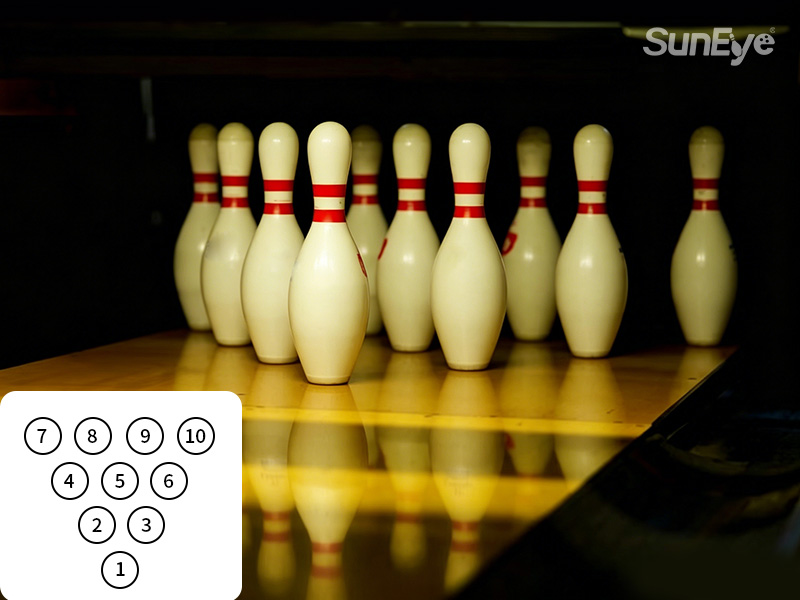
Each number represents a fixed location on the pin deck.
The No.1 Pin, also called the Head Pin, stands at the very front.
Professional bowlers constantly refer to these numbers.
Examples include:
l "Left a 7-pin."
l "Picked up the 10-pin."
l "Almost converted the 7-10 split!"
These numbers make communication much easier for players, coaches, and scoring systems.
Why Are Bowling Pins Arranged in a Triangle?
Great question!
The triangular formation isn't just for looks—it was carefully designed to maximize chain reactions.
When the bowling ball hits the head pin correctly, the impact spreads through multiple rows of pins, creating powerful collisions.
Think of it like a carefully arranged set of dominoes.
One good hit can send energy throughout the rack, giving you the satisfying explosion of a perfect strike.
If the pins were arranged in a straight line or square, strikes would actually be much harder to achieve.
The triangle offers the perfect balance between challenge and excitement.
Does Knocking Down Different Pins Score Different Points?
Here's a common misconception.
No. Every pin is worth exactly one point.
Whether you knock down:
l Pin 1
l Pin 5
l Pin 10
...each counts as one fallen pin.
So why do professional bowlers care so much about hitting the head pin?
Because where you hit matters much more than which pin you knock down.
A perfect shot usually enters the pocket:
l Between Pins 1 and 3 (right-handed bowlers)
l Between Pins 1 and 2 (left-handed bowlers)
This angle transfers the ball's energy efficiently through the rack, greatly increasing the chance of a strike.
So while every pin has equal value, their positions influence how easily the remaining pins fall.
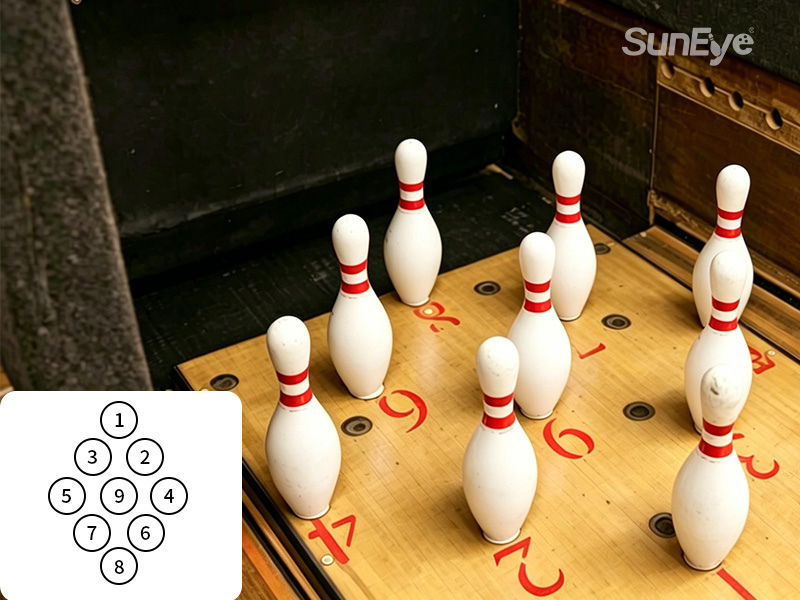
What About Nine-Pin Bowling?
Nine-pin bowling is one of Europe's oldest bowling games and remains especially popular in Germany, Austria, and several Central European countries.
Instead of ten pins, players bowl at nine pins arranged in a diamond shape.
Typical layout:
Compared with ten-pin bowling:
l Smaller playing area
l Different scoring system
l Distinct ball design
l Rich European heritage
Nine-pin bowling emphasizes precision and consistency rather than powerful hook shots.
What Is Five-Pin Bowling?
Five-pin bowling is Canada's unique contribution to the sport.
Instead of ten pins, only five pins are used.
Layout:
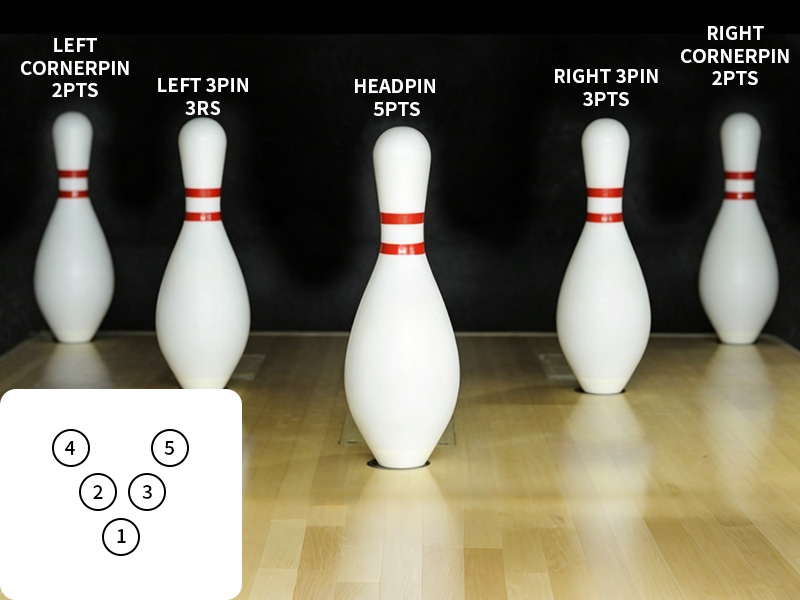
Unlike ten-pin bowling, each pin carries a different point value.
|
Pin |
Value |
|
Center Pin |
5 points |
|
Adjacent Pins |
3 points each |
|
Outside Pins |
2 points each |
Another unique feature is the smaller, lighter bowling ball with no finger holes, making the game accessible for players of all ages.
Duckpin Bowling: Small Pins, Big Fun
At first glance, Duckpin Bowling appears similar to traditional bowling because it also uses 10 pins.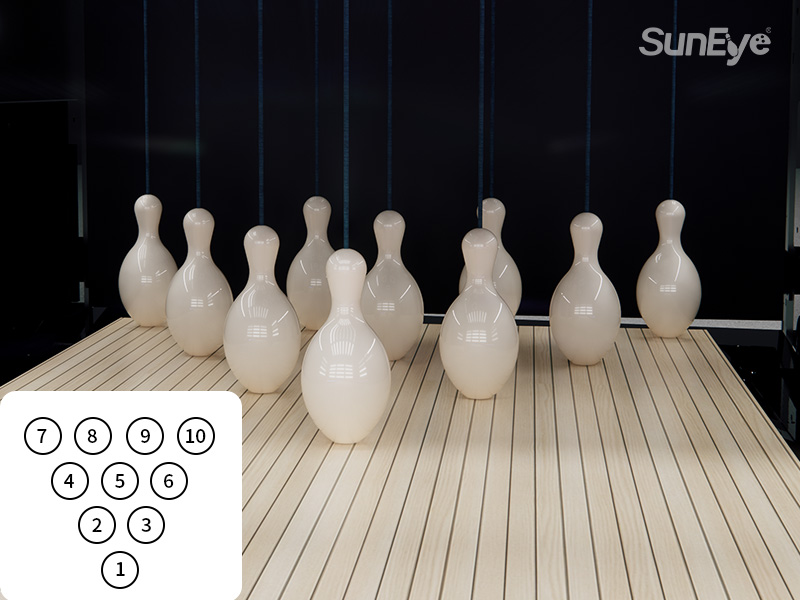
However, the differences are significant:
l Shorter lane (approximately 9 meters)
l Smaller pins
l Smaller bowling ball (no finger holes)
l Faster gameplay
l Easier for children and beginners
Because of its compact design, Duckpin Bowling has become increasingly popular in shopping malls, arcades, hotels, bars, and family entertainment centers.
Why Pin Design Matters
Modern bowling equipment is carefully engineered to ensure consistent pin action.
Pin height, weight, spacing, and material all influence how the pins react after impact.
At SunEye, we manufacture complete bowling solutions for multiple game formats, including:
l Standard Ten-pin Bowling
l Duckpin Bowling
l Mini Bowling
Each system is designed with optimized pin placement and reliable automatic string pinsetter technology to deliver smooth gameplay and consistent pin action.
Pin It to Win It
So, how many bowling pins are there?
The answer depends on the game:
🎳10 Pins – Standard Bowling, Duckpin, Candlepin
🎳 9 Pins – European Nine-pin Bowling
🎳5 Pins – Canadian Five-pin Bowling
Whether you're chasing your first strike or planning a new bowling center, every bowling game starts with one simple goal:
Knock down as many pins as possible—and have fun doing it!